
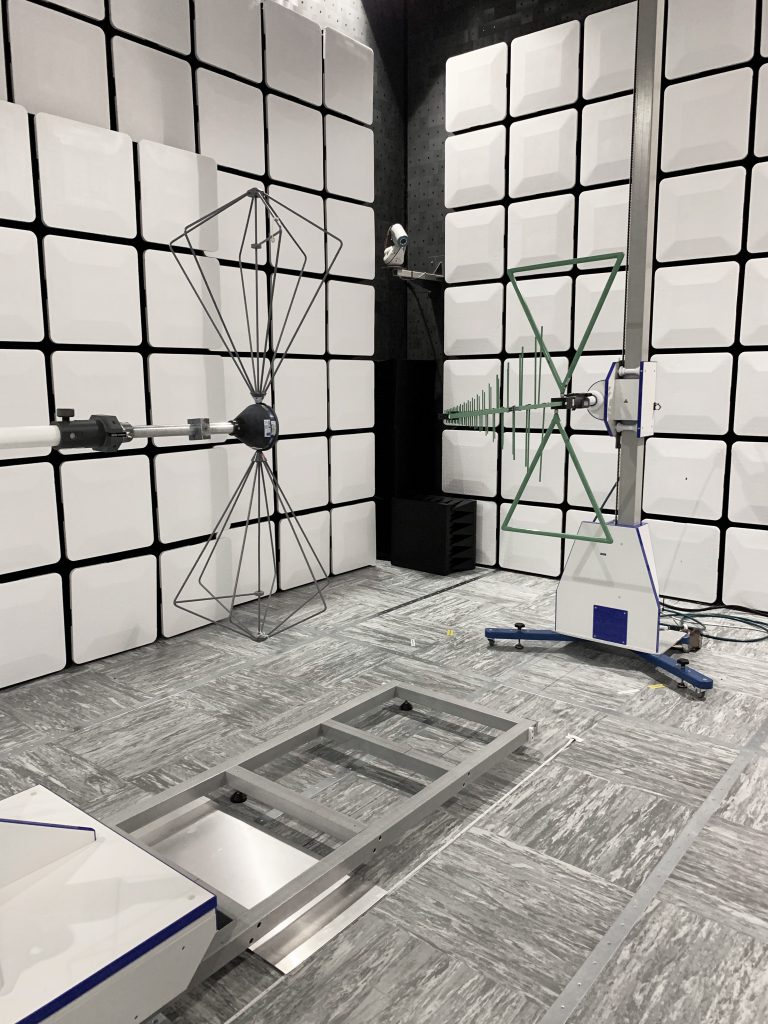
UNECE Regulation No. 10 Revision 6 (R10.06) testing is an automotive electromagnetic compatibility assessment used to demonstrate that a vehicle or electronic sub-assembly (ESA) does not produce excessive electromagnetic emissions and maintains proper functional performance when subjected to electromagnetic disturbances.
It is a regulatory approval requirement for a wide range of automotive electrical and electronic products intended for installation in vehicles within markets adopting UNECE regulations.
The VCA and E-Mark Approval
The Vehicle Certification Agency (VCA) is the UK’s national approval authority responsible for certifying that vehicles and automotive systems meet required safety, environmental, and regulatory standards. For EMC approvals, the VCA:
- Assesses test evidence submitted by test laboratories
- Issues UNECE type approval certificates (including R10 approvals)
- Ensures compliance with UNECE regulations applied in the UK and internationally
- Acts as an official approval authority recognised under UNECE agreements
- Generates the “E” marking required for automotive products.
To obtain an E-mark under R10.06, test evidence must be submitted to the VCA by an accredited laboratory. The VCA reviews the technical documentation, assesses results against the regulation’s requirements, and issues a UNECE type approval certificate when satisfied. The resulting E-mark serves as the visible declaration that the product has been assessed and approved under the relevant regulation.
For ESA manufacturers, the approval pathway runs through the laboratory, not directly through the vehicle manufacturer. Choosing an accredited laboratory early simplifies the path to submission and reduces the risk of procedural delays.
What EMC testing evaluates
Electromagnetic compatibility (EMC) testing ensures that a device:
1. Does not emit excessive electromagnetic noise within is product standard guidelines.
2. Will continue to operate safely if exposed to electromagnetic disturbance within its intended environment.
EMC testing looks at a device in two ways:
Emissions testing checks how much radiation or electrical noise a device sends into its surroundings. In vehicles, many systems are close together and share power and signal lines. If an ESA goes over the allowed limits, it can interfere with nearby systems, including important functions such as braking, steering, or driver assistance.
Immunity testing checks how a device works when exposed to electromagnetic disturbances. Vehicles face tough electromagnetic conditions, both from internal sources like ignition systems and motors, and from external sources like radio transmitters and cell networks. If an ESA does not have enough immunity, it might reset, act unpredictably, or stop working.
Standards applied under Reg 10.06
CISPR 25 covers radiated and conducted emissions from vehicle components. The primary concern is protection of on-board radio receivers, including AM/FM, DAB, GPS, and cellular systems. An ESA generating noise in relevant frequency ranges can degrade receiver performance across the vehicle.
ISO 7637 series addresses transient voltage disturbances on vehicle power lines caused by normal operation: switching inductive loads, engine cranking, load dump events, and relay switching. Many real-world ESA field failures trace to inadequate transient immunity rather than conventional emissions non-compliance.
ISO 11452 series covers radiated and conducted immunity. Radiated immunity testing exposes the ESA to controlled electromagnetic fields while monitoring functional performance. Conducted immunity, typically performed using bulk current injection (BCI), introduces RF currents directly onto the wiring harness to simulate real-world coupling in a controlled, repeatable way.
Before Testing Begins
Hardware should be representative of the production design, including PCB layout, filtering, and shielding. The wiring harness configuration used during testing should reflect the intended vehicle installation and be fully documented. All relevant operating modes should be covered, particularly those most likely to produce worst-case emissions or immunity vulnerabilities. Documentation for VCA submission should be prepared in parallel with testing, not after.
EMC compliance is most effectively managed as a design consideration. Failures identified at type approval testing cost significantly more to address than those caught during development. Pre-compliance assessment helps engineering teams reach formal testing in a stronger position.
ETS EMC, part of NMi Group, is a UKAS-accredited, VCA-recognised laboratory supporting automotive OEMs, Tier suppliers, and ESA manufacturers through R10.06 compliance testing, development support, and type approval submissions.
Discover more about our ETS EMC testing.
Back